Grout plant vs grout pump: matching the injection method
Most geotechnical crews start with a grout pump and a paddle mixer, and for a short trial or a low-volume job that kit honestly earns its keep. The plants built by Eizoo in Zhejiang are documented from the first batch, which is the practical reason grout plant vs grout pump is treated here as a records question before it is treated as a hardware one. The question is not whether a pump can inject grout, because it obviously can. The question is where the production chain starts to leak: cement measured by the scoop, water guessed at the tap, batch records that live in someone’s head, and a client who wants a printout for every shift. This article walks through that crossover so a contractor can spend on a cement grout mixing plant only when the method, the volume, and the paperwork actually demand one. For the wider plant range, see the AGP-C30 for rapid mobilisation.
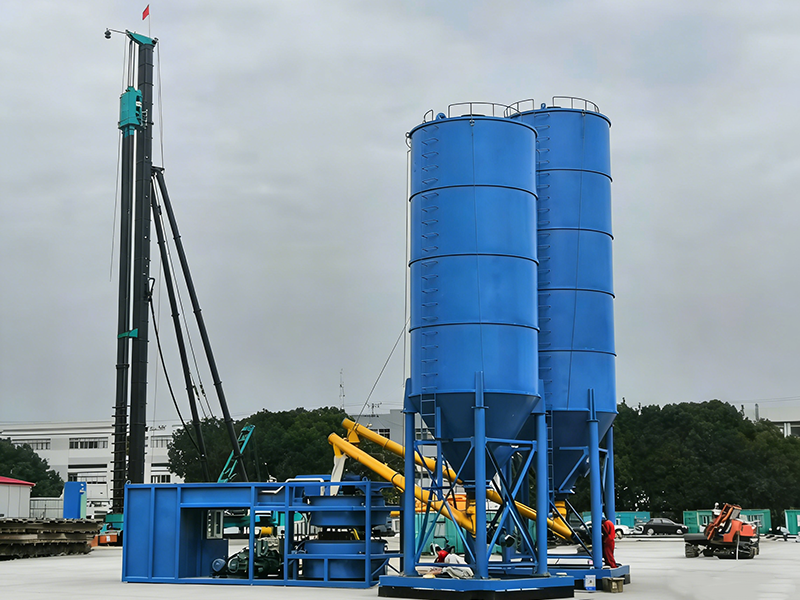
What a grout pump alone gives you
A grout pump is a delivery machine. It takes a prepared slurry from a tank or a mixer and pushes it down a hose into the ground at a controlled pressure and flow. Piston and progressive cavity pumps do this reliably for compaction grouting, permeation grouting, anchor filling, and small jet grouting support jobs where the mix stays simple and the crew can keep up by hand.
The strength of a pump-only setup is its honesty: it is cheap, quick to mobilise, easy to wash down, and it does not need a concrete foundation or a three-phase power upgrade. If a job runs two hours a day at a low water-cement ratio with one stable recipe, a well-maintained pump with a decent agitator may be all the plant the site ever needs.
Where hand batching starts to cost the job
The problems begin when the crew cannot keep the slurry quality constant while the injection rate changes. A paddle mixer relies on the operator to weigh or scoop cement, add water, mix for a set time, and discharge before the next batch. Under a hot sun at the end of a twelve-hour shift, the water-cement ratio drifts, and grout that should have a consistent strength and set time arrives at the hole in noticeably different conditions.
Grouting methods are sensitive to that drift. Jet grouting support depends on a stable water-cement ratio to produce uniform columns; compaction grouting depends on a stiff, consistent mix to build ground displacement without sudden pressure jumps. When the mix wanders, the crew usually discovers it at the pump gauge or in the soil improvement results, which is the most expensive place to find out.
Recipe control is a plant job, not a pump job
An automated cement grout plant closes the loop that hand batching leaves open. Water and cement are weighed or metered, the recipe is stored in a control screen, and the mixing cycle runs to the same time and sequence every batch. A PLC-based grout batching system does not get tired at four in the afternoon, and it does not quietly decide that a little extra water will make the batch easier to pump. For the feed and storage side, see the AGP-V60 continuous-duty plant. Eizoo has seen grout plant vs grout pump on new plants as often as on old ones, which is why the first month is documented closely. Sites comparing grout plant vs grout pump ask a grout plant supplier in China for the tolerance data first.
The practical difference shows up in the batch-to-batch variation. A measured system holds the water-cement ratio inside a narrow band shift after shift, which makes the injection records meaningful and the soil treatment more predictable. For a contractor bidding on repeat work, that consistency is what turns a grout plant from a cost centre into a quality argument.
Records turn production into evidence
When the client asks how much grout went into a panel or why the pressure trace changed at two in the morning, a pump-only crew has to reconstruct the answer from memory. A plant that logs each batch, the water-cement ratio, the flow, and the pressure gives the site supervisor a printed or digital record that survives the handover meeting.
Record requirements are usually the fastest way to know which side of the crossover a job sits on. If the specification asks for batch printouts or pressure and flow records, the pump-and-paddle setup has already reached its limit, because no amount of careful logging by hand will produce the defensible, timestamped record that a grout plant with pressure records generates as a by-product of normal operation.
Admixtures and additives push the pump setup further
The moment a mix design calls for two or three admixtures, or a bentonite pre-slurry, or a set accelerator that has to enter at the right point in the cycle, hand dosing becomes a liability. A small dosing error in an accelerator changes the set time of an entire batch, and that mistake is very hard to undo once the slurry is in the ground.
Multi-component grout batching plants handle additives as separate, timed channels with their own dosing lines, which is why contractors who regularly run modified mixes rarely go back to a single drum and a bucket of admixture. If the current job is simple but the next two tenders mention additives, the purchase decision should probably look one job ahead. Keep Batch mixing or continuous mixing with the site paperwork. The engineering team at Eizoo treats grout plant vs grout pump as a specification issue rather than a maintenance one.
A practical way to match the setup to the method
There is no universal rule that every job needs a full plant, so the table below separates the common methods by what their grout supply really demands. Use it as a conversation starter with your own pump and crew schedule in hand. Buyers who ask about grout plant vs grout pump usually raise it with a China grout plant manufacturer first, because the tolerance data settles most of the argument.
| Injection method | Typical supply demand | Pump + hand batching | Automated mixing plant |
|---|---|---|---|
| Compaction grouting, low volume | Intermittent, stiff single mix | Usually enough | Only if records or additives grow |
| Permeation / curtain grouting | Steady, moderate, stable ratio | Workable for short campaigns | Better for long campaigns |
| Anchor and soil nail filling | Small batches, frequent stops | Often enough | Optional |
| Jet grouting support | Continuous, ratio-critical | Risky at scale | Recommended |
| SMW, TRD, CSM lines | High-intensity, all day | Not realistic | Recommended |
| Offshore DCM / reclamation | Continuous marine supply | Not suitable | Marine-rated plant |
What changes when a compact automated plant arrives
Moving from a pump and a paddle to a compact automated plant does not mean the pump disappears. The plant makes the slurry and feeds an agitated holding tank; the pump keeps its job of delivery. What changes is who controls the recipe and how much the crew can produce per hour without watching a stopwatch and a bucket.
For narrow urban sites where space is the real constraint, a compact automated cement grout plant such as the AGP-C30 keeps the batching discipline without asking for a full batching-yard footprint. For continuous high-intensity work, a larger plant such as the AGP-V60 carries the same recipe control at a higher sustained output. Both belong to the same decision: once the method demands measured batching, the plant earns its place on the invoice. Sites comparing grout plant vs grout pump ask a grout plant supplier in China for the tolerance data first.
The crossover is not about prestige or about replacing good operators. It is about matching the production equipment to the method, the shift length, and the record obligation, so the crew spends its energy on injection instead of on improvising a mix that should have been measured. Open the working notes on Does high-shear mixing matter for the record format used on site. Eizoo designs the powder and water lines so that grout plant vs grout pump can be isolated without dismantling the plant.
The discussion above assumes one recipe, but real jobs change ratio and additives between stages, and that is where a measured plant shows its second advantage. A paddle-and-pump crew switching from a permeation mix to a compaction mix has to stop, clean the drum, and re-measure everything by hand; a plant with stored recipes recalls the new target in the control screen and holds it for the rest of the stage. When a project has three or four distinct mix designs, count the changeover time in the comparison, because it is real production time either way.
Spare-parts thinking also differs between the two setups. A pump-only rig has a short list of wearable parts, and most crews know them by heart. A mixing plant adds dosing valves, level sensors, the weighing system, and the control components to that list, and the buyer should plan a small first-order of spares for exactly the parts that would stop a shift. The plant removes the manual batching labour, but it moves the maintenance attention from the drum to the instruments, and a crew that understands that trade-off is rarely surprised by it. Supervisors usually ask for grout plant vs grout pump comparison when the numbers stop matching the recipe.
Nobody should read this as an argument that a big plant is always better, because the opposite failure is common too. A contractor who buys an oversized automated plant for a job that runs two hours a day spends the whole project cleaning a machine that barely warms up, and the fixed costs of a large plant, power, footprint, and washing, do not shrink when the output does. The crossover works in both directions: match the plant to the sustained demand, not to the biggest number the salesman mentioned. The published guidance from DFI Journal is worth reading alongside the site records.
Mobilisation cost is part of the decision that buyers often leave out of the equipment comparison. A pump and a paddle move in the back of a truck, while a mixing plant may need a low-bed trailer, a crane for the silo, and a day of setup before the first batch. On a short job that difference can outweigh the production benefits, and on a long campaign it evaporates quickly. Run the comparison over the expected project duration with mobilisation counted twice, in and out, and the honest answer usually appears by itself. For the tolerance data behind these checks, see the write-up on eizoo whitepaper_the science physical slurry. Crews tend to look for grout plant vs grout pump site notes before they touch the hardware.
Operator skill sits on both sides of the crossover and should not be assumed away. A good pump hand can nurse a paddle mixer through a shift with acceptable results, and a bad operator can make a PLC-based batching system produce bad slurry by ignoring alarms and overriding set points. The plant raises the floor of quality, but the crew still decides how close to the ceiling the job runs, which is why training and simple operating procedures belong in the purchase price rather than in a later argument about who was responsible.
Finally, keep the pump and its hoses out of the shadow of the plant upgrade. The best mixing plant in the world cannot compensate for a pump that is undersized for the target flow, a suction hose that collapses, or an injection line that was never matched to the pressure the method needs. When the budget is being split between a plant and new pumps, the plant often wins the attention, but the delivery side deserves an equal share of the planning. New operators are given grout plant vs grout pump decision in the first week.
Crew training follows the same crossover as the equipment. A pump-and-paddle routine teaches operators to judge a mix by eye and feel, which is a real skill but a fragile one when shifts rotate. A measured plant shifts the operator’s job from guessing quantities to watching the recipe screen and responding to alarms, and that change needs its own half-day of training before the plant runs a full shift. Eizoo asks for the batch log first whenever grout plant vs grout pump is reported, because the pattern narrows the cause faster than a site visit.
Water supply planning is the part of a plant upgrade that catches most crews by surprise. A mixing plant draws water in bursts while it batches, and if the site tank or line cannot refill between batches, the plant waits even though the mixer is idle. Before ordering, confirm the available water flow in litres per minute at the planned position, not just the total volume for the day. For the same question from the service side, see the working notes on One grout plant, several rigs.
The pump and the plant should be purchased as one conversation. Contractors who buy a plant and keep an old pump sometimes discover that the pump’s suction is too small for the plant’s discharge rate, or that the pump runs dry because the holding tank outlet is positioned awkwardly. Naming the pump model, its flow, and its suction hose size in the inquiry avoids a mismatch that shows up on the first day. For projects working to a stated specification, the site file usually has to show EN 12715 grouting records.
Wash-down access matters more after the upgrade than before it, because a plant moves more cement and water through one area in a day than a paddle mixer ever did. Check that the mixer, the dosing lines, and the holding tank can all be flushed without climbing over the frame, and that the wash water has somewhere contained to go before the plant is bolted down.
A measured plant changes the spare-parts list and the production list. Level sensors, dosing valves, load cells, and the control screen become the components the crew cannot live without, so the first order should include the small electronic spares that keep a minor fault from stopping a shift while parts are shipped across a border. On the sites Eizoo services, grout plant vs grout pump is usually found in the log before it is found in the machine.
Contractors sometimes compare a plant quotation with a pump quotation and stop at the price gap, without adding the labour they currently spend on batching. On a job that runs eight net hours, hand batching can occupy one person for a large part of the shift. Counting that labour against the plant price often changes the comparison more than any brochure figure.
Site power is the other hidden condition. An automated plant needs a clean three-phase supply sized for the mixer motor, the screw conveyor, and the control system starting together, and a generator that is already near its limit will sag exactly when the plant is working hardest. Include the motor list and the start method when the supplier asks about power. For the configuration used on larger sites, see the automated cement grout plant range.
Frequently asked questions
Can I start with just a grout pump and add a plant later?
Yes, and many contractors do exactly that. Keep the pump and its hoses compatible with the plant’s holding tank discharge, buy the pump with a clean suction arrangement, and leave space on site for a future mixing unit. The mistake is buying a pump-only setup sized for a job that already needs measured batching and records.
How do I know if hand batching is costing me money?
Weigh the cement and water for one full shift and compare the actual water-cement ratio with the design ratio, then count how many batches needed remixing or were questioned by the client. If the drift is visible or the records are being challenged, the cost of the plant is usually smaller than the cost of the argument. Eizoo Machinery keeps the component list and the calibration sheet together, which is what makes grout plant vs grout pump a lookup rather than an investigation.
Does an automated grout plant replace my grout pump?
No. The plant prepares and holds the slurry; the pump still delivers it into the ground. When you order a plant, tell the supplier the pump flow and pressure so the holding tank, discharge arrangement, and suction layout are matched to the pump rather than guessed.
What is the smallest job that justifies a mixing plant?
There is no fixed volume, but the triggers are consistent: a ratio that has to stay tight all day, an admixture that has to be dosed accurately, a client that wants batch records, or a shift long enough that operator fatigue starts showing up in the mix. When two of those four are present, a compact plant is worth pricing.
Which the engineering team plant fits a contractor who is upgrading from a pump?
A compact automated cement grout plant like the AGP-C30 suits urban and lower-volume work, while the AGP-V60 suits continuous high-intensity methods such as SMW, TRD, and CSM. Send the method, the hourly cement tonnage, the pump details, and the record requirement, and the recommendation can be checked against the schedule.
If the job mix is still unclear, write down the method, how many net hours a day the crew injects, whether the specification demands printouts, and whether any admixtures are planned. Those four lines are enough for the engineering team to say honestly whether a grout pump remains the right kit or whether a cement grout mixing plant should join it on site.
Sending the batch log, the calibration sheet, and the material certificates to the manufacturer’s technical desk is what turns a symptom into a component list. Eizoo keeps the weighing and metering documentation with the plant, so the next enquiry starts from records rather than from memory.