HKIA Third Runway: Offshore DCM Grout Supply at 40 m3/h
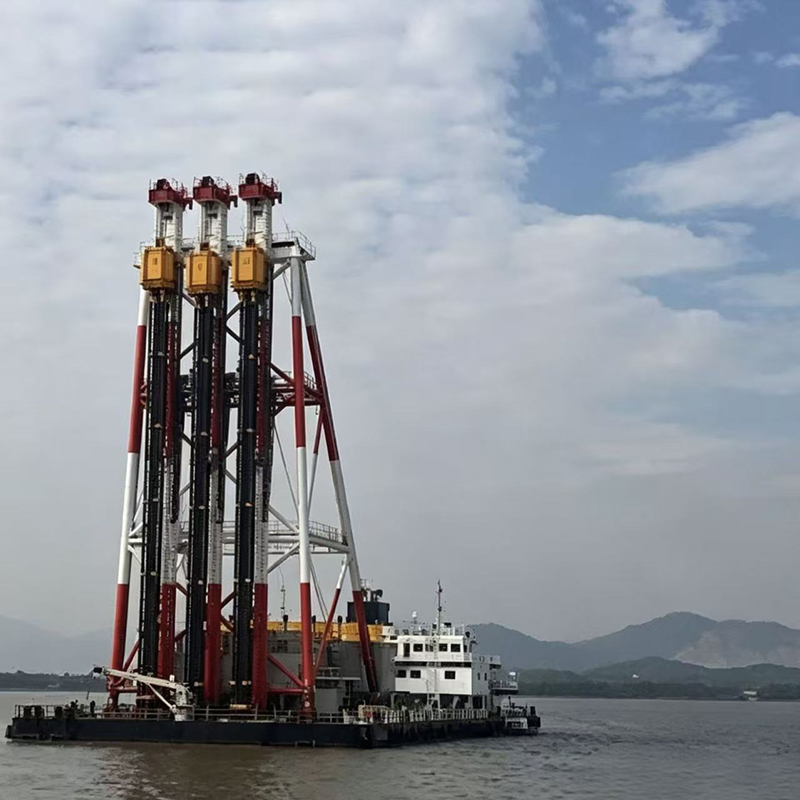
The third runway at Hong Kong International Airport is one of the largest aviation reclamation projects built in recent years. Much of the land the runway and its associated taxiways stand on was created by deep cement mixing: an offshore fleet of DCM barges treating soft marine deposits in place so that the reclamation above them behaves as engineered ground rather than as sediment.
Project overview
The scope was massive offshore Deep Cement Mixing reclamation for the airport expansion. DCM is a volume business. The barges work continuously, their output is measured in treated cubic metres per shift, and the slurry plant that feeds them is upstream of everything: if it stops, the fleet stops.
The technical challenge
Two things made this demanding. The first was intensity: high-intensity, 24/7 continuous slurry supply. Continuous is the operative word. A plant sized for a campaign with natural breaks behaves very differently from one that is expected to run without pause for weeks.
The second was the environment: an extreme marine setting with high salinity and humidity. Salt-laden air attacks coatings, enclosures and electrical connections, and on an offshore campaign there is no convenient moment to deal with it.
The EIZOO solution
The plants deployed were the AGP-M (Marine) Series, delivering 40 m³/h throughput to match the demand of large-scale offshore DCM barges. Matching output to the fleet is the sizing question that governs an offshore campaign: too small and the barges wait, too large and you have paid for capacity that never runs.
The key achievement was high-throughput reliability — sustained 24/7 operation with zero rig downtime, which demonstrated the durability of the heavy-duty transmission systems under continuous marine loading.
What continuous offshore duty demands of a plant
- Throughput matched to the fleet, not to a shift average. Size against the peak draw of the barges working together, then confirm the powder line and water supply can hold it.
- Transmission and drive durability. Continuous duty turns minor weaknesses into failures. Gearbox, coupling and bearing specification matter more than on intermittent work.
- Corrosion protection as a design input. Marine coating, enclosure rating and material choices need to be in the original specification.
- Spares and service access. Offshore, a part that takes three days to arrive costs three days of fleet time. What is stocked matters as much as what is fitted.
- Supply continuity. Cement and water logistics are part of the plant specification on an offshore campaign, not an afterthought.
Lessons that transfer to other DCM work
| Decision | What offshore DCM changes |
|---|---|
| Output sizing | Match the barge fleet peak draw, not the daily average |
| Transmission specification | Continuous duty rating replaces intermittent rating |
| Corrosion protection | Marine coating and enclosure rating become primary line items |
| Spares strategy | On-site critical spares are cheaper than fleet downtime |
| Powder and water supply | Logistics capacity sets the achievable output |
Related equipment and reading
Offshore campaigns of this scale are typically served by marine-configured plants with integrated bulk storage. See our notes on the AGP-M500 marine digital grout plant, on selecting a marine grout plant for offshore DCM, reclamation and port work, and on the power and water utilities that decide whether a plant reaches full output.
Frequently asked questions
Why is 24/7 continuous duty harder than the same output in shifts?
Because nothing cools down, nothing gets inspected between cycles, and wear accumulates without the natural breaks that let a crew catch a problem early. Every component has to be rated for continuous service rather than intermittent service.
How should output be sized for a DCM campaign?
From the peak simultaneous draw of the barges you intend to run, with allowance for the logistics that keep cement and water arriving. Sizing against a daily average under-delivers exactly when the fleet is working hardest.
What causes most unplanned stops offshore?
Supply interruptions and corrosion-related faults, more often than the mixing or pumping stage itself. That is why logistics and coating specification deserve as much attention as output.
Does a marine plant differ from a land plant beyond the coating?
Yes. Layout, access for maintenance, enclosure rating, bulk storage integration and how the plant is secured and transported are all configured differently for marine service.