Mexico Port and Malaysia Shipyard: Marine Grouting Cases
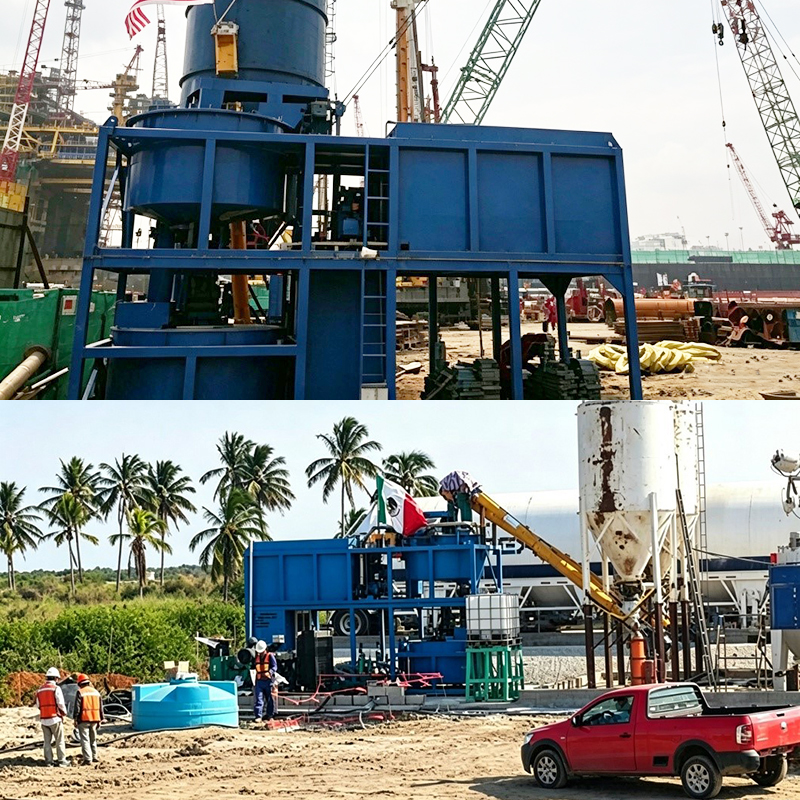
Two jobs on opposite sides of the Pacific and South China Sea, one brief: keep a grout plant running at a remote coastal site where a breakdown means a flight, not a van. Pier reinforcement at Ensenada Port in Mexico (2020) and foundation stabilisation for a heavy shipyard in Malaysia share more than their coastline — both put equipment into conditions that a plant built for inland work will not tolerate.
The projects
- Mexico, Ensenada Port (2020): pier reinforcement, working over and alongside water on an operating port structure.
- Malaysia, heavy shipyard: foundation stabilisation supporting heavy industrial loads.
The challenge
Three conditions defined the work. Extreme heat, which affects mix temperature, working window and the cooling of hydraulic and drive systems. High humidity, which encourages cement to cake in silos and conveyors and accelerates corrosion. And salt spray corrosion, which attacks every exposed surface continuously.
The projects were also remote coastal sites, which changed the maintenance arithmetic. On a site like this, reliability is not a preference; a plant that requires zero-downtime operation has to be built so that nothing routine can take it out of service without notice.
The EIZOO solution
Marine protection
Units were equipped with field-proven heavy-duty anti-corrosion coatings specified to resist severe salt spray degradation. Coating choice is easy to value-engineer away and expensive to replace once the plant is on site in a corrosive atmosphere.
Technical support on site
Senior engineering specialists were dispatched for cross-ocean mobilisation, commissioning and operator training. On remote work, commissioning and training are not extras: they are what converts a delivered machine into output, and they are what keeps small problems from becoming long stops.
The result
Zero downtime was recorded throughout the project cycles. The combination of corrosion-hardened equipment and on-site technical support delivered proven field durability across the Pacific and Southeast Asia.
What remote coastal duty asks of a specification
| Condition | What it does to the plant | What to specify |
|---|---|---|
| Extreme heat | Shortens mix working window, stresses drives and hydraulics | Cooling capacity, shaded siting, water temperature management |
| High humidity | Cement caking, accelerated corrosion | Silo ventilation, sealed conveyors, coating specification |
| Salt spray | Progressive attack on steel, enclosures and fasteners | Marine coating system, enclosure rating, fastener material |
| Remote location | Parts and expertise are days away | Critical spares held on site, remote diagnostics, trained crew |
| Continuous operation | No natural breaks for inspection | Continuous-duty ratings, planned maintenance windows |
Planning checklist for coastal and overseas mobilisation
- Confirm the coating and enclosure specification against actual salt exposure, not a generic “marine” label.
- Send spares with the plant, chosen from the wear parts list rather than from what is cheap to ship.
- Book commissioning and operator training into the mobilisation schedule, not after it.
- Plan cement storage around humidity: ventilation, sealed transfer and a cleaning routine.
- Plan water supply for both mixing and cooling before the plant arrives.
- Agree a remote support path — what the crew can diagnose and who they reach.
Related equipment and reading
For specification background on this duty, see marine grout plant selection for offshore work, the containerised plant buying guide for remote and all-weather sites, and the site layout and mobilisation checklist.
Frequently asked questions
Is a marine coating worth the extra cost on a short coastal job?
Usually yes, because corrosion damage is cumulative and a single coating failure can remove a machine from service. On short campaigns the risk is often higher, not lower, since there is no time built in for repairs.
How does heat affect grout on site?
Higher mix temperature shortens the working window and accelerates set, which shows up as blockages and pressure problems rather than as a mixing fault. Managing water temperature and siting is part of the plan.
Why is on-site commissioning and training so important remotely?
Because the crew will meet problems that a manual does not cover, and because a small operational mistake on a remote site can cost days rather than hours.
What spares should travel with the plant?
The wear parts and the components whose failure stops the machine: seals, hoses, contactors, sensors and the specific mixing and conveying parts listed in the maintenance schedule.