Hong Kong-Zhuhai-Macao Bridge: Island Foundation Grouting
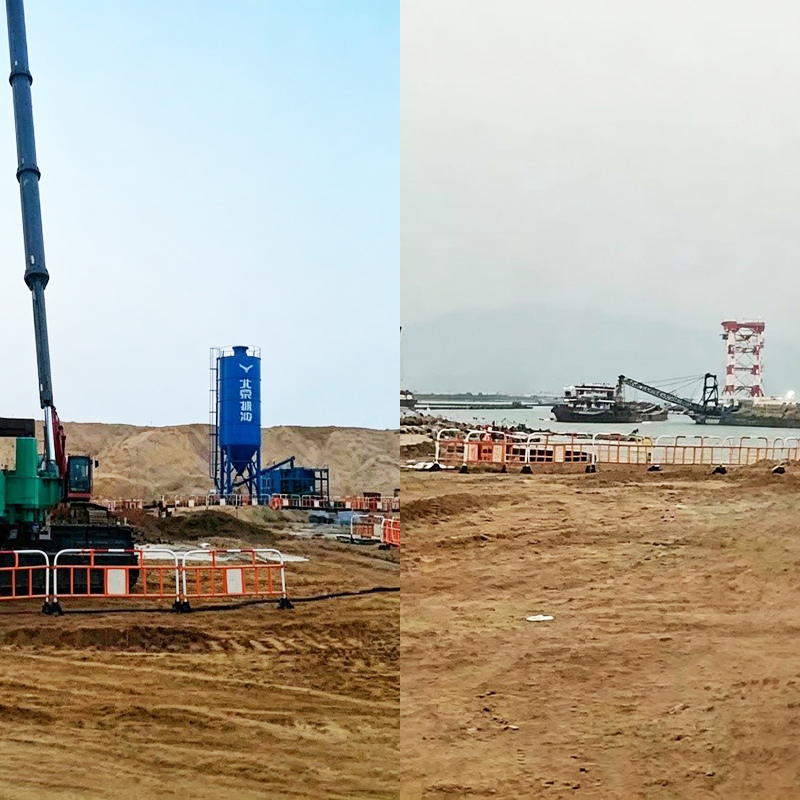
The Hong Kong-Zhuhai-Macao Bridge is a fixed link across the Pearl River Estuary, combining a long bridge section with an immersed tunnel and two artificial islands that carry the transition between them. The islands are constructed reclamations standing in open water, and the strata beneath them had to be treated before they could carry the loads of the tunnel approaches and the bridge transition structures. Foundation reinforcement for the Hong Kong section artificial island ran in 2015.
What the site asked of the grouting equipment
Two requirements governed the work. The first was corrosion: the plant sat in an environment of intense marine salt spray, which attacks structural steel, electrical enclosures, fasteners and any exposed machined surface. Equipment that performs well inland can lose a season to corrosion on an exposed marine reclamation.
The second was documentation. Grouting in deep-sea strata carries requirements on both grout strength and data integrity. When the work is below water and permanently inaccessible, the record of what was injected is the only evidence that the specification was met.
How the plant was configured
Physical activation of the slurry
The units used EIZOO’s high-intensity shear activation approach. Cement agglomerates that survive conventional mixing leave unhydrated cement in the grout and increase bleed, which matters more when the grout has to perform in saturated marine strata. Driving the dispersion harder converts more of the cement and produces a more stable suspension.
Heavy-duty marine protection
The plants were engineered with a field-proven marine coating system specified to withstand the salt spray loading on site. Coating is the least visible part of a grout plant specification and one of the most consequential on a marine campaign, because corrosion damage accumulates silently and then removes a machine from service at the worst moment.
Computerised control with encrypted data logging
The plants carried EIZOO’s computerised control system, which logged data in encrypted form and exported reports securely. That produced audit-ready compliance documentation automatically, at a time when digital record requirements were far less common than they are now.
The outcome
The units ran reliably through a complex construction cycle. For a project of this type, that is the result that matters: the grouting line is not the headline scope, and its job is to stay out of the way while the island structures go in. Stable operation across the full cycle, with the compliance record generated as a by-product, is what a marine foundation grouting package is supposed to deliver.
What buyers can take from it
| Requirement on this project | What it implies for a plant specification |
|---|---|
| Continuous marine salt spray exposure | Specify the coating system, enclosure rating and fastener material, not just the output |
| Grout strength in deep-sea strata | Mixing energy and dispersion matter as much as the mix design |
| Data integrity and reporting | Encrypted logging and export belong in the original specification, not a retrofit |
| Long, complex construction cycle | Wear parts, spares and service access decide uptime more than nameplate output |
Two of these — corrosion protection and data records — are routinely left out of enquiries and then requested once the plant is on site. Both are far cheaper to specify than to add.
Related equipment and reading
Marine campaigns of this type are typically served by plants configured for continuous duty and protected against salt loading. For background on the specification decisions involved, see our notes on marine grout plant selection for offshore DCM and reclamation, on the AGP-M500 marine digital grout plant, and on what physical slurry activation does to a cement grout.
Frequently asked questions
Why does salt spray matter so much for a grout plant?
Because corrosion attacks the parts that keep a plant running: enclosures, connectors, fasteners and structural steel. On an exposed marine site the failure is rarely sudden; it is accumulated damage that removes a machine from service when you can least afford it.
Why is data integrity specified on marine works?
The treated ground is below water and permanently inaccessible after construction. The injection record is the only evidence available that the specification was achieved, so it forms part of the project deliverable.
Is high-intensity shear activation necessary on every job?
No. It earns its place where bleed, penetrability or strength at a fixed cement content governs. On high-volume void filling where strength is not the limiting factor, it is generally not the right investment.
Can data logging be added to an existing plant later?
It can, but retrofitting instrumentation and integrating it with the control system costs far more than specifying it in the original build, and the record may not be accepted as tamper-evident.