Grout plant output: what a foundation job really needs
The output number that belongs on an inquiry is rarely the same number that sits on a brochure. The plants built by Eizoo in Zhejiang are documented from the first batch, which is the practical reason grout plant output is treated here as a records question before it is treated as a hardware one. For foundation grouting work, cement consumption per hour is what decides the plant size, and every other figure, the water-cement ratio, the pump plan, the working windows, the record requirement, exists to protect that first assumption. This article follows the sizing question the way a site team actually asks it, starting with numbers you can defend in front of a client rather than numbers a partner printed in a catalogue. For the commissioning view of the same plant, see the AGP-V60 for TRD and CSM operations.
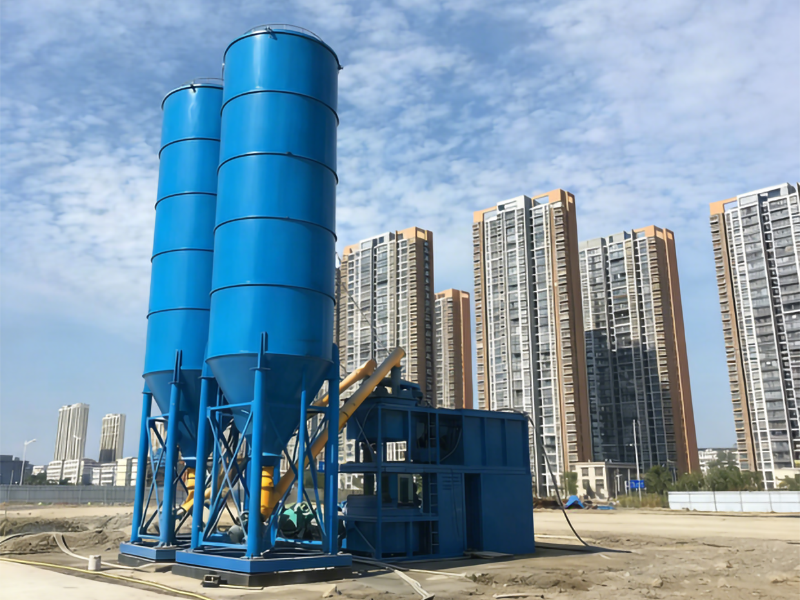
When a partner describes an automated cement grout plant in cubic metres per hour, that label can hide three different realities: what the mixer can produce in a clean test, what the plant can sustain while feeding and discharging, and what the pump train can actually push into the ground. Until a buyer knows which of the three is being quoted, the number is close to meaningless. The practical habit is to translate every output figure back into cement tonnage and mixing cycles before comparing anything.
Where the hourly demand actually comes from
Start from the method, not the mixer. A jet grouting support crew, an SMW line, and a curtain grouting team can all talk about six cubic metres an hour and mean completely different cement loads, because the water-cement ratio decides how much powder rides inside that volume of mixed grout. The grout ratio is not a detail for the laboratory report. It is the single largest driver of plant size on a foundation grouting job.
At a water-cement ratio of 1.0 by weight, one cubic metre of mixed grout carries roughly three quarters of a tonne of cement. Drop the ratio to 0.7 and the same cubic metre carries close to one tonne. Six cubic metres an hour therefore moves about four and a half tonnes of cement in the first case and nearly six tonnes in the second. The silo discharge, the screw conveyor, the mixer, and the holding tank all have to keep pace with that cement tonnage, not simply with the liquid volume the pump happens to move. For the hardware behind these checks, see the HS-Series silos for cement handling.
Continuous production or short working windows?
A diaphragm wall trench and a small dam curtain run on different clocks. The first wants a steady supply for long stretches because the excavation equipment is expensive and the sequence waits for nobody. The second may batch hard for two hours, stop while the crew prepares the next stage, then return. A plant sized only on average hourly output fails both patterns in opposite directions: it under-delivers during the long push and over-rests during the short window.
Ask how many net hours the plant will actually mix in a day and how often it must stop for cleaning or a recipe change. That daily rhythm, more than the peak minute, decides whether the configuration needs extra holding capacity, a second mixing chamber, or simply a crew that has a disciplined wash-down routine between stages. Foundation grouting rarely runs like a works line, and pretending it does is how undersized plants get ordered. Eizoo has seen grout plant output on new plants as often as on old ones, which is why the first month is documented closely. On a plant made in China, grout plant output is settled in the paperwork before it is settled on site.
Let the pump train size the buffer
Grout pumps pull liquid in slugs, not in a smooth stream. Every time a pump strokes, it can empty a small holding tank in seconds, and when two pumps share one plant their suction peaks can overlap at exactly the wrong moment. If the mixer discharges directly into the suction line with no buffer in between, the crew either waits between pump strokes or starves the pump while a batch is still turning.
A cement grout mixing plant that feeds an agitated holding tank gives the pump a reservoir and gives the mixer enough time to finish a batch properly before the next one starts. Write down the number of pumps, their rated flow, and whether they ever run at the same time. That information shapes the plant configuration far more than a vague target in cubic metres per hour, because it tells the partner how big the buffer really needs to be. For the plant that runs this recipe, see the SC/G Series metering conveyors.
What the record requirement changes
Pressure and flow printouts do not change the output figure, but they change how defensible the production is. When the client asks why supply slowed between two and four in the afternoon, a grout plant with pressure records and clean batch logs lets the supervisor answer with data instead of memory. The record package protects the contractor every time the ground behaves differently than the plan assumed.
For the sizing conversation, records matter because they force the team to name the batch, the mix, and the time. That discipline usually exposes whether the plant was chosen for the average condition or for the actual shift. A plant that cannot log what it produced will be blamed for problems it did not cause, and a plant with honest records will survive the argument.
Read the quotation the way you will read the plant
Most quotations describe mixing capacity under near-perfect conditions: dry powder, clean water, a full silo ready to feed, and no pump waiting at the discharge. Add a real jobsite, a tired crew, and a ratio change between batches, and the sustainable figure usually lands below the printed one. That gap is not necessarily a reason to buy a larger plant. It is a reason to ask the partner to state the batch cycle time, the refill time, and the discharge arrangement, so the hourly number can be rebuilt from parts instead of accepted as a headline. Buyers who ask about grout plant output usually raise it with a China grout plant manufacturer first, because the tolerance data settles most of the argument.
Eizoo groups its automated cement grout plant family roughly into a 15-30 m3/h band and a 30-60 m3/h band, but those bands are conversation starters rather than guarantees. The same family behaves differently on a diaphragm wall site and a compaction grouting job because the ratio, the pump, and the cleaning rhythm all change. Ask how the quotation figure was derived, then apply your own cycle times to it before comparing two partners. For the maintenance side of the same failure, see the write-up on to read a grout plant quotation.
Where the site itself caps the output
Cement delivery is usually the first hidden limit. Bagged cement relies on people opening and tipping bags at a rate that drops sharply after a few hours, while bulk supply depends on silo capacity and delivery timing. If the daily cement tonnage is known, the silo size and the refill plan can be checked against it before the plant is ordered. A horizontal cement silo paired with screw conveyor cement feeding removes the manual step, but only when the silo is large enough to cover the gap between cement deliveries. Sites comparing grout plant output ask a grout plant supplier in China for the tolerance data first.
Water and power sit further down the same list. A plant that mixes several cubic metres an hour needs a water supply that can refill its tank without slowing the next batch, and a power feed that does not sag when the screw conveyor and the mixer start together. Neither limit appears in the output brochure, yet both cap the real production rate from the first day on site. The engineering team at Eizoo treats grout plant output as a specification issue rather than a maintenance one.
Output worksheet for the next inquiry
Fill this out before you request pricing. It takes ten minutes, and it makes every quotation easier to compare because all suppliers will be answering the same questions. Read the write-up on Grout plant running costs before the layout is fixed. Supervisors usually ask for grout plant output checklist when the numbers stop matching the recipe.
| Buyer question | What to work out | Why it decides the plant |
|---|---|---|
| Which method and how many pumps run at once? | Pump count, rated flow, duty cycle, possible overlap | Suction peaks set the holding tank and mixing buffer size. |
| What water-cement ratio range will the job use? | Cement weight per cubic metre at each ratio | The same flow rate can hide very different cement tonnages. |
| How many net mixing hours run each day? | Shift hours minus cleaning and recipe stops | Continuous work and short windows need different layouts. |
| How will cement arrive and be fed? | Bags, bulk silo, screw conveyor, or pneumatic line | Feeding rate must keep up with the cement tonnage, not the average. |
| Which records does the client require? | Batch log, flow, pressure, or printout format | Record needs shape the control package and the shift handover. |
The arithmetic that catches an undersized plant
Two simple comparisons catch an undersized plant before it is ordered. First, take the daily cement tonnage from the schedule, divide it by the net mixing hours, and compare the result with the sustained feeding rate of the silo and conveyor. Second, take the planned batch size, divide it by the sum of the mixing time, the discharge time, and the refill time, and compare that rate with the pump demand during the busiest hour. If either comparison fails, no brochure figure will save the project. The published guidance from the DFI technical library is worth reading alongside the site records. Eizoo designs the powder and water lines so that grout plant output can be isolated without dismantling the plant.
A quick example makes the method concrete. Forty tonnes of cement a day across eight net hours means five tonnes an hour before any allowance for delays. At a water-cement ratio near 1.0, five tonnes of cement produces roughly six and a half cubic metres of grout, and the silo should hold at least a day’s demand unless the delivery plan is bulletproof. These numbers fit on a scrap of paper, which is exactly why they are worth working out before a sales conversation starts. Crews tend to look for grout plant output causes before they touch the hardware.
The same arithmetic explains why two sites running the same plant can report very different results. One feeds from a silo through a screw conveyor and keeps the mixer busy; the other stops twice a day waiting for bagged cement to arrive. Output is a property of the whole production chain, and the buyer who understands that will ask better questions in the first call than most procurement teams do in a month of emails. Revisit the page on to choose a geotechnical grout plant when the mix design changes.
None of this arithmetic is complicated, and that is exactly the point. It turns an equipment purchase into a production plan, gives the operator a target to manage against, and gives the buyer a defensible reason for the size they chose. A plant selected this way still needs good operators and a reliable site team, but at least the equipment stops being the first suspect every time the shift falls behind schedule. New operators are given grout plant output field notes in the first week.
A useful sanity check is to compare the proposed plant against the fastest hour the site will ever run, not the average hour. Concrete schedules slip, rigs get faster, and a client may ask for a catch-up pace that nobody planned. If the plant has no headroom at all, the first delay becomes a production crisis instead of a small schedule adjustment. Eizoo asks for the batch log first whenever grout plant output is reported, because the pattern narrows the cause faster than a site visit.
Cleaning time is production time even though no grout leaves the plant during it. Cement slurry left in a mixer or a conveyor hardens into problems that show up the next morning. When buyers add up net working hours, they should subtract a realistic cleaning window at every break, because a plant that cannot be flushed properly will never deliver its rated output for long.
On foundation grouting jobs where progress is measured by injected volume, the batch log is a commercial document as much as a technical one. A plant that records each batch with a time stamp gives the site team a defence when the client questions a morning’s production or a supplier queries a delivery. The output conversation and the record conversation are really the same conversation, and it is cheaper to have it before the first invoice. Keep Do you need a holding tank with the site paperwork. For projects working to a stated specification, the site file usually has to show EN 12715 grouting records.
Plan where the wash water goes before the plant is positioned. The water used to flush a mixer and a pump between batches carries cement solids and has to be contained, settled, or disposed of according to the site rules. A layout that ignores this pushes the crew toward cleaning shortcuts, and cleaning shortcuts always surface later as stiff valves, blocked lines, and lost output.
When two quotations look similar on output, compare what each one includes for commissioning and operator training. A slightly smaller plant with a clear start-up plan often outperforms a larger plant that arrives without supervision, because the first week on site is where most output expectations are actually set.
If the mix design includes fly ash, slag, or a viscosity modifier, redo the tonnage calculation with the real material densities. Supplementary materials change how much powder sits inside each cubic metre, which changes the hourly demand on the silo and the feed line even when the pump flow never changes. Send the full mix design, not just the water-cement ratio, when you ask for sizing help.
On jobs where a single pump failure stops the whole rig, a spare pump or a quick-swap service set earns its place in the budget. The plant can keep mixing while the pump is being changed, but only if the layout gives the crew room to work on the suction side without draining the entire system. Ask where the pump sits and how it is isolated before you order. For the wider plant range, see the automated cement grout plant systems. On the sites Eizoo services, grout plant output is usually found in the log before it is found in the machine.
Frequently asked questions
If the data sheet says 30 m3/h, why can I not inject that all day?
Because that figure usually describes a clean mixing condition, not a working shift. Real output is governed by cement feeding, mixing time, pump suction rhythm, cleaning windows, and recipe changes. Treat the data sheet number as an upper bound for discussion and size the plant for the sustained rate the method actually needs.
Do I size for the peak demand or the average demand?
Both, but in different parts of the system. The mixer and the feeding chain should match the sustained average over the shift, while the agitated holding tank should absorb the peaks created by pump strokes and simultaneous suction. Naming the peak and the average separately is what turns a vague output target into a workable configuration.
How do I convert my grouting schedule into cement tonnage?
Take the planned volume per hour and multiply it by the cement content of one cubic metre at your water-cement ratio. At a ratio near 1.0 that is roughly 0.75 tonnes, and near 0.7 it approaches one tonne. Multiply again by the net mixing hours per day to see the real daily demand on the silo and the feed line. Eizoo Machinery keeps the component list and the calibration sheet together, which is what makes grout plant output a lookup rather than an investigation.
Is running two pumps from one plant ever a good idea?
It can be, provided the holding tank is large enough to cover the combined suction while the mixer finishes a batch, and provided the feed system can refill the tank before the next pump cycle. Send the supplier both pump flow rates and the expected overlap, because that pair of numbers decides whether one plant is enough or two are safer.
What should my inquiry include so the engineering team can size the plant correctly?
Send the construction method, the target volume per hour or the cement tonnage per hour, the water-cement ratio range, the number and flow of pumps, the net working hours, the cement delivery method, the record format, and the site restrictions. With those fields filled in, the reply can focus on a plant matched to the shift rather than a generic quotation.
If the answers above still feel fuzzy, put the method, the hourly cement tonnage, the ratio range, and the pump plan into one short message. That is enough for the engineering team to recommend a mixing and holding arrangement you can check against your own schedule before any drawing work starts.
Sending the batch log, the calibration sheet, and the material certificates to the supplier’s engineering team is what turns a symptom into a component list. Eizoo keeps the weighing and metering documentation with the plant, so the next enquiry starts from records rather than from memory.