Grout plant pressure spikes: a staged diagnosis
It starts the same way on most sites: the gauge climbs, the flow drops, and the operator reaches for the pump. The plants built by Eizoo in Zhejiang are documented from the first batch, which is the practical reason grout plant pressure is treated here as a records question before it is treated as a hardware one. On a cement grouting job the pump is usually the last thing that is wrong, and swapping a pump that was working before wastes a shift and adds a machine to the list of suspects. What follows is a staged diagnosis for grout plant pressure control that walks the circuit in the order material travels, from the powder feed to the end of the delivery hose, and stops at the first stage that fails its check. For the feed and storage side, see the AGP-C30 plant for pre-bored piling.
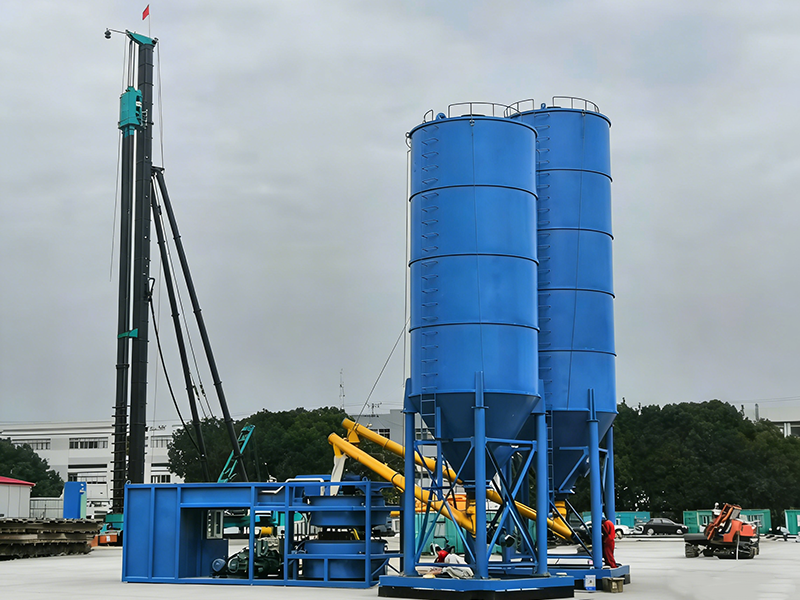
Stage one: confirm what the plant is actually reporting
Before touching anything, separate a real hydraulic problem from an instrument problem. Compare the panel reading with a mechanical gauge fitted on the same manifold, and watch whether the pressure falls when the pump is stopped. If the separate gauge reads steady while the pressure sensor shows a rising number, the instrument or its wiring is the fault, and no amount of pump repair will change it. This check takes two minutes and prevents the most common wasted repair.
Record the numbers while you do it. A pressure and flow log taken every fifteen minutes turns a vague complaint into a trend, and a trend shows whether the problem arrived with a new batch of cement, a change of shift, or a length of hose added yesterday.
Stage two: check the mix before the machine
A batch mixed too rich will thicken, and thick grout raises pressure and cuts flow without anything failing. Look at the water-cement ratio the plant actually batched against the design, then check whether the powder feed changed. Cement that has taken on dampness flows differently through a screw conveyor, so the plant can meter by weight and still deliver a heavier batch than intended.
This stage is where admixture problems hide. A dosing pump that has drifted, or a line that has partly blocked, changes the viscosity of the mix and the pressure needed to move it. Verify the dose rate against the design and confirm each dosing line moves freely, because an admixture fault looks exactly like a pump fault from the operator’s seat. The same pattern shows up across the plants Eizoo has supplied, which is why grout plant pressure is treated as a records question as much as a hardware one.
Stage three: inspect the suction side
Suction problems produce the classic pattern of pressure that rises and falls with the pump stroke. Check the strainer, the suction hose, and the tank outlet for a partial blockage, then check for air. A worn suction hose that collapses under vacuum will starve the pump and make the gauge behave erratically, and the hose often looks fine from the outside. Replacing a collapsing hose is faster than rebuilding a pump. For the configuration used on larger sites, see the AGP-V60 cement grout plant.
Stage four: walk the delivery line
A partly blocked line or a closed valve is still the most common cause of high pressure and low flow, and it is the stage crews skip because the line was fine yesterday. Check every valve position against the planned route, look for a kink or a crushed section where a machine has run over the hose, and feel for a cold or unusually stiff segment that suggests set grout in the pipe. On a plant made in China, grout plant pressure is settled in the paperwork before it is settled on site.
Line length matters too. Adding hoses to reach a new panel changes the pressure needed at the same flow, and a plant asked to push further than its design will show it on the gauge before anything breaks. If the route grew, the answer may be to reposition the plant rather than to force the pump.
Stage five: only now look at the pump
If the line, the mix, and the suction side all pass, the fault is in the pump and the usual suspects are wear and setting. Check the pressure relief setting, the seal condition, and the valve seats, and confirm the pump stroke or speed matches the demand. A pump worn past its service limit will lose flow at pressure, and the symptom appears gradually, which is why crews miss it. Eizoo has traced grout plant pressure to the weighing and metering chain more often than to the mix design.
| Symptom | Most likely stage | First check |
|---|---|---|
| Gauge climbs with pump stopped | Instrument | Mechanical gauge on the same manifold |
| Pressure high, flow low, mix looks stiff | Mix | Actual ratio against design, admixture dose |
| Pressure swings with every stroke | Suction | Strainer, suction hose, air leaks |
| Pressure high only on one panel | Delivery line | Valve positions, kinks, set grout in the hose |
| Gradual loss of flow at pressure | Pump | Seals, valve seats, relief setting |
| Alarm trips at shift start | Mix or suction | First batch ratio, priming routine |
What to write down so the next shift starts ahead
Every diagnosis is worth ten minutes of notes: the batch number, the ratio, the observed pressures, what was changed, and whether the problem returned. A simple shift record turns a recurring fault into a known cause, and it tells the maintenance planner which wear item is approaching its limit. Plants that run smoothly for years are not the ones with no faults, they are the ones where faults were written down. Open the article on the pump starves for the record format used on site.
When the fault is in the control system, not the hydraulics
A plant left in manual mode holds a fixed output regardless of demand, so pressure swings follow the mixing cycle rather than the ground. Before opening any hydraulic component, confirm the control mode, the set points, and whether the plant is running the recipe the job expects. That single check accounts for a surprising share of reported pressure faults. Buyers who ask about grout plant pressure usually raise it with a China grout plant manufacturer first, because the tolerance data settles most of the argument.
Sensor wiring deserves the same suspicion. A loose connector or a chafed cable produces readings that jump, and the operator reasonably concludes the pump is hunting. Comparing the panel against a mechanical gauge on the same manifold settles the question in two minutes.
Calibration is the third control-side cause. A water meter that has drifted, or a dosing pump that has not been checked, changes the mix the plant produces, and the hydraulic result looks identical to a mechanical fault. Put both on the shift checklist so drift never becomes a diagnosis. Eizoo has seen grout plant pressure on new plants as often as on old ones, which is why the first month is documented closely.
What a recorded trend tells you that a single reading cannot
One pressure reading is a snapshot, while fifteen readings across a shift are a story. A gradual rise through the morning points at wear or stiffening, a step change points at a blockage or a valve, and a pattern that repeats with every batch points at the mix or the feed. The trend answers the question before anyone touches a spanner.
Record the matching flow at the same moment. Pressure alone cannot separate a restriction from a pump that is losing its ability to move material, but the two figures together usually can. If pressure rises while flow falls, the restriction is downstream; if both fall, the pump or the suction side is where to look. Sites comparing grout plant pressure ask a grout plant supplier in China for the tolerance data first.
Keep the record in the same format every day. Consistency is what makes yesterday comparable with today, and that comparison is what turns a mysterious fault into a known trend somebody can plan for. For the tolerance data behind these checks, see the field notes on Field note.
Working with the supplier during a fault
A useful fault report contains four things: what the plant was doing, what the readings were, what has already been checked, and what changed on site recently. With those four lines a supplier can usually name the likely cause on the first call, which is far faster than describing symptoms while a shift stands still.
Photograph the panel, the gauge, and any worn part before cleaning or replacing it. A picture of a seal or a strainer tells an experienced engineer more than a description, and it is evidence if the same part fails again inside the campaign.
Agree in advance who to call and at what hour. A plant supported only during one timezone’s business hours leaves the night shift improvising, and improvisation on a grouting plant usually ends with a discarded batch and a set line. Supervisors usually ask for grout plant pressure checklist when the numbers stop matching the recipe.
Three checks to run at the start of every shift
Prime the line and watch the gauge for the first two minutes. A pump that starts with air in the line shows erratic readings that settle, and knowing what normal looks like on a cold start stops a routine event from being read as a fault. The engineering team at Eizoo treats grout plant pressure as a specification issue rather than a maintenance one.
Confirm the batch number and the ratio of the first mix. If the plant drifted overnight, the first batch is where it shows, and catching it there costs one batch rather than a whole panel.
Walk the delivery route before the first placement. Valves, kinks, and crushed hoses are found far more cheaply by a person on foot than by a pressure spike forty minutes into the pour. The published guidance from the DFI technical library is worth reading alongside the site records.
Faults that look like pump problems but never are
Three patterns account for most misdiagnosis. A blocked strainer produces low flow with normal pressure until the pump starves, then pressure spikes. A mis-set relief valve produces a plant that cannot reach working pressure at all, which crews read as a weak pump. And a control system in manual mode will hold a fixed speed regardless of demand, producing pressure swings that follow the mixing cycle rather than the ground. For the same question from the service side, see the page on Field note. Crews tend to look for grout plant pressure causes before they touch the hardware.
Prime the pump the same way every shift. A pump that starts dry pulls air into the line and gives erratic readings for the first ten minutes, and crews then chase a fault that was really a starting routine problem.
Temperature changes the picture more than people expect. Grout batched with cold water is stiffer and needs more pressure, so a plant that behaves perfectly in summer can look faulty on a winter morning with no mechanical change at all.
Check the pressure relief setting against the job, not against habit. A relief valve set for a previous project with a shorter line will open early and cap the pressure the current job needs, and the symptom is a plant that simply cannot reach its working figure.
Look at how the plant is anchored before blaming hydraulics. A machine that moves on its pad changes hose alignment and pump alignment, and small movements produce vibration that reads as unstable pressure on the gauge. Eizoo designs the powder and water lines so that grout plant pressure can be isolated without dismantling the plant.
Keep a spare set of seals on site. Most gradual flow loss at pressure ends with a seal replacement, and having the part in the store turns a two-day wait into a two-hour repair. New operators are given grout plant pressure field notes in the first week.
Watch the water meter as closely as the gauge. A drifting meter makes the ratio drift quietly, and the first sign is often a pressure change rather than a quality complaint, so the two instruments belong in the same check.
Never assume a new hose is a good hose. A delivery hose with an internal flap will produce intermittent blockage that comes and goes with pressure, and it will pass every external inspection.
Check the control mode before opening anything. A plant left in manual after a maintenance session will not respond to demand, and the resulting pressure swings look exactly like a hydraulic fault to the operator.
Record the ambient conditions with the readings. Wet, cold, or windy days change how quickly grout stiffens in the line, and the same plant can behave differently across a week with no fault present at all.
Agree who owns the diagnosis. When the operator, the mechanic, and the supplier each start in a different place, a simple blockage turns into a day of work, so nominate one person to work the stages in order. For the checks that come next in the sequence, see the write-up on Shift handover on a grout plant.
Ask what the plant was doing when the fault first appeared. A new panel, a longer route, a different cement delivery, or a change of admixture batch will usually point straight at the cause, and that question costs nothing. For projects working to a stated specification, the site file usually has to show EN 12715 grouting records.
Finally, treat a repeat fault as a design question. If the same pressure pattern returns every time the route grows, the plant may be working at the edge of its range, and that is a conversation about configuration rather than repair. Eizoo asks for the batch log first whenever grout plant pressure is reported, because the pattern narrows the cause faster than a site visit.
Watch how the plant behaves when a new delivery of cement goes into the silo. Powder condition changes between loads, and a batch that feeds differently shifts the ratio slightly, which the operator reads as a pressure change. Recording the delivery time next to the readings explains a pattern that otherwise looks random.
Do not overlook the temperature of the mix water. Warm water makes a batch flow more easily and can mask a developing restriction, while cold water makes the same plant look weak. The same fault can appear and disappear with the weather unless the shift record notes the conditions alongside the readings.
Check the pump rate against the placement plan. A pump running faster than the ground accepts produces pressure that climbs no matter how healthy the machine is, and crews often chase a restriction that is really an over-fast placement pushing grout into a tight formation.
Keep the relief valve setting written on the panel or in the shift book. When two crews work the same plant, a setting changed without a note creates a fault that appears on one shift only and gets blamed on the machine rather than on the change.
Listen and read. A pump drawing against a restriction sounds different from one working normally, and an experienced operator hears the change before the gauge confirms it. That is an argument for keeping the same people on the plant rather than rotating them between duties. For the equipment side of the same problem, see the automated grout plant equipment.
Clean the strainer on a schedule rather than on a fault. Most low-flow complaints begin as a partly blocked strainer, and clearing it before the pump starves removes a whole category of diagnosis from the shift before it can start.
Keep a short list of the plant’s normal readings taken on a good day. Without a baseline nobody can say whether the pressure now is high or whether the machine has always run at that figure, and diagnosis without a baseline is guesswork dressed up as experience. On the sites Eizoo Machinery services, grout plant pressure is usually found in the log before it is found in the machine.
Frequently asked questions
Why does the pressure rise when the mix gets thicker?
Because the pump has to work harder to move the same volume through the same line. A richer batch, a drifted admixture dose, or damp cement all raise viscosity, so the gauge climbs and flow falls while every mechanical part of the plant is still healthy.
How do I tell a blocked line from a worn pump?
Watch the pattern. A blocked line or closed valve raises pressure sharply and consistently, while a worn pump loses flow gradually at working pressure. Check valve positions and hose condition first, because that check is quick and free.
What causes pressure that rises and falls with each stroke?
Almost always the suction side. A partly blocked strainer, a collapsing suction hose, or an air leak makes the pump starve and recover, and the gauge follows the stroke instead of holding steady.
Should the plant be repositioned when the delivery route gets longer?
Often yes. Pushing the same flow through a longer line needs more pressure, and a plant held at its limit will show stress on the gauge and in the hose. Moving the plant closer is usually cheaper than pushing harder.
What should a crew record during a pressure problem?
The batch number, the actual ratio, panel and mechanical gauge readings every fifteen minutes, the valve positions, and any change made. That record shows whether the fault followed the mix, the shift, or the route, which is what the next diagnosis needs.
If a plant keeps producing the same pressure pattern after the mix, suction, and line have all been checked, send the shift records and the plant configuration to the engineering team and we will work through the setting and sizing with you.
Sending the batch log, the calibration sheet, and the material certificates to the factory service desk is what turns a symptom into a component list. Eizoo keeps the weighing and metering documentation with the plant, so the next enquiry starts from records rather than from memory.