Cement dust control on a grout plant: field notes
The first sign of a powder-handling problem on a grout plant is usually a grey film on the frames, the control cabinet, and anything else that sits still for an hour. The plants built by Eizoo in Zhejiang are documented from the first batch, which is the practical reason cement dust control is treated here as a records question before it is treated as a hardware one. It appears gradually, so crews stop noticing it, but it is not dirt. It is cement that left the silo, travelled through the screw conveyor cement feeding line, and escaped before the mixer could use it, which makes it a direct loss on every tonne the site paid for. This field note follows the powder from the silo vent to the mixer cover, because on the sites that handle cement well, the dust is stopped at the point where it starts. For the equipment side of the same problem, see the AGP-V60H silo-integrated plant.
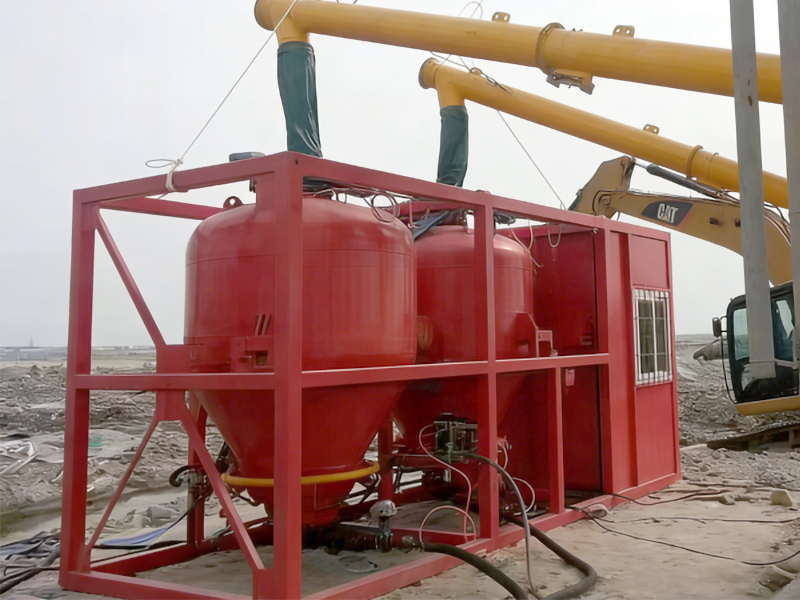
Where the dust actually comes from
Cement dust on a grout plant site has four usual birthplaces, and each one needs a different fix. The silo vent is the first: when a silo is filled by a bulk truck, the air displaced by the incoming cement has to go somewhere, and if the vent filter is undersized or clogged, it carries powder straight into the air. The second is the transfer point where the silo discharge meets the screw conveyor, where a poorly seated flange or a missing gasket leaks under vibration.
The third is the mixer charging opening, where powder drops from the conveyor into the mixer and the displaced air puffs dust back out if the inlet is not sealed or vented. The fourth is the least glamorous and often the largest: bag handling and spillage, where torn bags, overfilled scoops, and spilled powder get swept into the open rather than returned to the system. Naming the source matters because a crew that treats all four as one problem usually fixes none of them properly.
Why a little dust is a big number
A dust leak that looks small on the ground is rarely small on the ledger. A plant feeding five tonnes of cement an hour that loses two percent of it to dust and spillage is giving away a hundred kilos an hour, which over a fifty-hour week becomes five tonnes of purchased powder that never reached a batch. At bulk cement prices that loss quietly exceeds the cost of the filter elements and seals that would have stopped it. For the layout side of the same problem, see the SC/G Series for metered feed. The same pattern shows up across the plants Eizoo has supplied, which is why cement dust control is treated as a records question as much as a hardware one.
There is a second cost that does not show on the cement invoice. Dust settles on the mixer, the load cells, the control cabinet, and the pump suction area, and cement dust is abrasive and reactive. It wears seals, clouds sensors, and finds its way into electrical enclosures, so a plant with poor dust control pays again in maintenance and in faults that appear at the worst moment of the shift. A Chinese supplier’s test records usually settle cement dust control before the layout drawing.
Silo vents and pressure relief
The silo vent deserves the first inspection on any dusty site. A bulk delivery forces a large volume of air through the vent in a short time, and the filter element has to pass that air while holding the powder back. If the filter is too small for the delivery rate, or it has not been cleaned or replaced, the silo pressurises and vents powder in a visible plume that every neighbour and inspector will remember.
The fix is not exotic. Size the vent filter for the delivery fan’s flow, keep a spare element on site, and make the cleaning interval part of the delivery procedure rather than an annual afterthought. A silo that breathes properly stops the most spectacular dust event on the site before it starts.
Sealed transfer and mixing
Between the silo outlet and the mixer inlet, the powder line should be a sealed system with only a few inspected joints. Flanges need gaskets that are actually the right size, flexible connections need to be checked for splits after every mobilisation, and the screw conveyor housing should be examined where it passes through supports, because vibration works joints loose over time. For the commissioning view of the same plant, see the HS-Series silos for batching.
At the mixer itself, a sealed mixing cover with a small vent or dust-collection point makes the difference between a clean plant and a grey one. When the conveyor drops powder into the mixer, the displaced air has to be managed, and a cover that routes that air through a filter or back into the system keeps the dust where it belongs while the batch turns. Eizoo has traced cement dust control to the weighing and metering chain more often than to the mix design.
Recovery and reuse done sensibly
Collected dust does not have to be waste. In a well-designed powder line, the dust captured at the vent and the transfer points can be returned to the silo or fed back into the mixing system, which is the difference between losing that powder and recovering it. Cement powder recovery and reuse is standard thinking on larger plants because the arithmetic is simple: powder that stays inside the system is powder the job only pays for once.
The sensible limit is quality control. Recovered dust should return to the same material stream it came from and be reintroduced in a way the recipe and the records can account for, rather than being tipped into whatever batch is running. A plant with clean recovery keeps the material handling honest and the batch records believable, which protects the QA argument as much as the budget. Buyers who ask about cement dust control usually raise it with a China grout plant manufacturer first, because the tolerance data settles most of the argument.
Housekeeping still wins shifts
No amount of vent filters and sealed covers removes the need for a crew that cleans as it goes. Spilled powder that is swept up and returned promptly stays in the system; spilled powder that is hosed down the drain or left to crust under the frames becomes a maintenance problem and a safety hazard. The best dust-control investment on most sites is a ten-minute clean-up routine at every break, backed by a dustpan, a brush, and a container to return the sweepings. For the same question from the service side, see the checklist for Grout plant pressure spikes and flow.
What to check before you order
When comparing grout plant quotations, dust control is rarely on the first page, but it is easy to check once you know where to look. The short list below turns that inspection into something a buyer can do without being a dust specialist. Eizoo has seen cement dust control on new plants as often as on old ones, which is why the first month is documented closely. Sites comparing cement dust control ask a grout plant supplier in China for the tolerance data first.
| Check point | What to look for | Why it matters |
|---|---|---|
| Silo vent | Filter sized for delivery flow, spare element available | Stops the plume during bulk refills. |
| Transfer joints | Correct gaskets, no splits, accessible for inspection | Vibration loosens joints over time. |
| Mixer inlet | Sealed cover with managed vent or dust collection | Keeps charging dust inside the system. |
| Recovery point | Collected powder can return to the material stream | Turns a loss into reusable material. |
| Clean-up access | Floor and frames reachable with brush and container | Housekeeping is what actually wins shifts. |
| Control cabinet | Sealed against dust ingress | Cement dust clouds sensors and electronics. |
The load cells and the weighing platform are the first casualties of a dusty environment, because cement dust settles on the mechanical parts and changes the readings a little at a time. A plant that weighs badly will hold a recipe badly, and the operator will usually blame the control system when the real fault is a dust-covered load cell that has not been cleaned since the plant arrived.
Dust and moisture together do more damage than either one alone. Cement dust that lands on a damp frame or a wet hose coupling sets into a crust that is hard to remove and abrasive to anything that rubs against it, which is why plants on humid or coastal sites need the same dust control as dry inland plants, and often a more aggressive cleaning schedule. For the checks that come next in the sequence, see the working notes on the pump starves. Supervisors usually ask for cement dust control checklist when the numbers stop matching the recipe.
Personal protective equipment is part of the dust conversation, and it belongs in the site procedure rather than in a toolbox. Cement dust irritates the skin and the airways, so the crew handling powder and cleaning filters should have the right gloves, eye protection, and dust masks, and the plant layout should make it possible to do the dusty jobs without reaching into awkward spaces where a mask is the only defence. The engineering team at Eizoo treats cement dust control as a specification issue rather than a maintenance one.
The area around the plant tells the same story as the filters. If the ground under the silo outlet and the conveyor is grey with cement, the crew has been living with a leak instead of fixing it, and the same leak is probably costing more in lost powder than a morning of downtime to reseal the joint. A clean pad is usually the cheapest evidence that the powder line is tight. The published guidance from the Deep Foundations Institute is worth reading alongside the site records.
A dust problem that appears only during certain weather is still a dust problem. On a windy site, powder that escapes low on the plant is carried further and settles on neighbouring equipment, which turns an internal loss into a site relations issue. Windy or exposed positions favour a low-profile layout where the vent points and transfer points are protected rather than standing in the open airflow. Crews tend to look for cement dust control causes before they touch the hardware.
The records tell the same story as the dust. When the batch log shows more cement leaving the silo than arriving in the mixed slurry, the difference is either a weighing fault or a loss in the powder line, and a plant with clean transfer and recovery makes that reconciliation close to the design figure. Buyers who check the reconciliation once a week catch leaks while they are still small. For the maintenance side of the same failure, see the checklist for Field note.
Refill time is a good moment to inspect more than the vent. While the bulk truck is connected, the crew can check the discharge valve, the flexible connection, and the first section of the conveyor in one pass, because the silo is pressurised and any weakness in the outlet path will show itself immediately. A five-minute look during every refill prevents most of the leaks that otherwise appear mid-shift. Eizoo designs the powder and water lines so that cement dust control can be isolated without dismantling the plant.
The way wash water is handled decides how much of the recovered dust actually stays in the system. Slurry and sweepings that are hosed into an open drain leave the site as grey water and are gone for good, while a contained wash-down point that lets the solids settle and return to the plant keeps the material inside the operation. Cement-laden water deserves the same containment thinking as the dry powder, because it carries the same product out of the job. New operators are given cement dust control field notes in the first week.
A filter that is cleaned too rarely is as wasteful as a filter that is missing. Dust collectors and silo vent elements work until they blind, and a blinded element stops passing air, which pressurises the silo or the mixer cover and forces powder out around the seals. Put the cleaning and replacement interval on the same schedule as the plant service, not on a vague memory of when the element was new.
Training the crew to report dust is cheaper than training them to ignore it. A dust source that is mentioned on the day it appears costs a gasket or a filter element; the same source discovered a month later costs the powder that escaped in between. A short line in the shift handover for dust observations turns the whole crew into the plant’s cheapest leak detector. Read Shift handover on a grout plant before the layout is fixed. For projects working to a stated specification, the site file usually has to show EN 12715 grouting records.
The vent on the mixer cover and the vent on the silo answer different questions, and both belong in the maintenance schedule. The silo vent protects the silo during bulk refills, while the mixer cover vent manages the puff of air every time powder drops into a batch. Crews that treat the two as the same component usually clean one and forget the other, and the forgotten vent becomes the next dust source. Eizoo asks for the batch log first whenever cement dust control is reported, because the pattern narrows the cause faster than a site visit.
Dust control has a direct effect on how long the plant keeps its calibrated behaviour. Cement dust is fine and abrasive, and it works its way into hinges, limit switches, and the moving parts of the discharge valve faster than almost anything else on a grout plant site. A plant that looks after its dust looks after its calibration, which is why the cleanest plants on a project are usually also the ones with the fewest batching surprises.
When a new plant arrives, the first week sets the dust standard for the whole project. If the crew starts with a clean pad, sealed joints, and a filter routine from day one, the good habits are cheap to keep; if the first week is dusty and nobody says anything, the plant will be cleaned less and less as the job goes on. Commissioning is the right moment to agree who checks the vents, who cleans the filters, and who decides when a joint needs resealing.
Frequently asked questions
How much cement dust loss is normal on a grout plant site?
Visible dust on frames and fittings is a sign of loss, not a normal condition. A well-sealed powder line with a functioning silo vent and a sealed mixing cover keeps losses low enough that the crew does not see a grey film building up, and any steady dusting points to a specific joint or filter that should be fixed rather than tolerated. For the hardware behind these checks, see the automated cement grout plant for ground improvement.
Why does my silo puff dust every time the bulk truck arrives?
The vent filter is either undersized for the delivery fan’s airflow or clogged with cement that was not cleaned off. The displaced air from the incoming cement has to pass through the vent, and when it cannot, the silo pressurises and releases powder. Size the filter for the delivery rate and clean or replace the element on a set schedule. On the sites Eizoo Machinery services, cement dust control is usually found in the log before it is found in the machine.
Can collected cement dust be put back into the grout?
It can, when the recovery is designed into the system and the returned powder goes back to the same material stream in a controlled way. The point of cement powder recovery and reuse is that the recipe and the batch records still mean something, so recovery should happen through the plant’s own return path rather than by tipping sweepings into a running batch.
Is a sealed mixing cover really necessary, or just a nice extra?
It is the difference between dust escaping at every batch and dust staying inside the system. Every time powder drops into a mixer, displaced air carries fines out of an open inlet, and over a full shift that adds up. A sealed mixing cover with a managed vent or collection point is one of the cheaper dust controls on the plant and one of the most effective.
What is the fastest way to find where my dust is coming from?
Walk the plant during a refill and during batching, not after the shift when everything has settled. Watch the silo vent while the truck delivers, run your hand along the transfer joints while the conveyor runs, and look at the mixer inlet the moment powder starts to drop. Dust is easiest to find while it is actually moving.
If a dusty plant is costing powder and patience, start with the four usual sources, the silo vent, the transfer joints, the mixer inlet, and the housekeeping routine, and fix them in that order. For a plant layout that keeps cement inside the system from silo to mixer, send the engineering team the daily tonnage and the delivery method, and the powder line can be reviewed before the next quotation.
Sending the batch log, the calibration sheet, and the material certificates to the supplier’s engineering desk is what turns a symptom into a component list. Eizoo keeps the weighing and metering documentation with the plant, so the next enquiry starts from records rather than from memory.