Integrated Construction Project of Yangzhou East Railway Station Comprehensive Transportation Hub
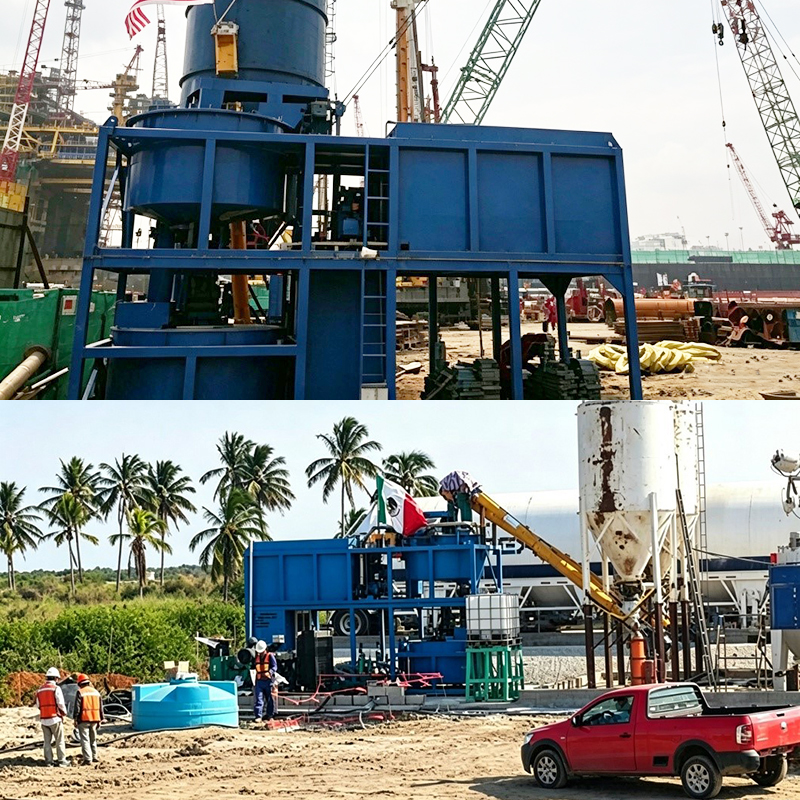
Mexico Port and Malaysia Shipyard: Marine Grouting Cases
Two jobs on opposite sides of the Pacific and South China Sea, one brief: keep a grout plant running at a remote coastal site where a breakdown means a flight, not a van. Pier reinforcement at Ensenada Port in Mexico (2020) and foundation stabilisation for a heavy shipyard in Malaysia share more than their coastline — both put equipment into conditions that a plant built for inland work will not tolerate.
The projects
- Mexico, Ensenada Port (2020): pier reinforcement, working over and alongside water on an operating port structure.
- Malaysia, heavy shipyard: foundation stabilisation supporting heavy industrial loads.
The challenge
Three conditions defined the work. Extreme heat, which affects mix temperature, working window and the cooling of hydraulic and drive systems. High humidity, which encourages cement to cake in silos and conveyors and accelerates corrosion. And salt spray corrosion, which attacks every exposed surface continuously.
The projects were also remote coastal sites, which changed the maintenance arithmetic. On a site like this, reliability is not a preference; a plant that requires zero-downtime operation has to be built so that nothing routine can take it out of service without notice.
The EIZOO solution
Marine protection
Units were equipped with field-proven heavy-duty anti-corrosion coatings specified to resist severe salt spray degradation. Coating choice is easy to value-engineer away and expensive to replace once the plant is on site in a corrosive atmosphere.
Technical support on site
Senior engineering specialists were dispatched for cross-ocean mobilisation, commissioning and operator training. On remote work, commissioning and training are not extras: they are what converts a delivered machine into output, and they are what keeps small problems from becoming long stops.
The result
Zero downtime was recorded throughout the project cycles. The combination of corrosion-hardened equipment and on-site technical support delivered proven field durability across the Pacific and Southeast Asia.
What remote coastal duty asks of a specification
| Condition | What it does to the plant | What to specify |
|---|---|---|
| Extreme heat | Shortens mix working window, stresses drives and hydraulics | Cooling capacity, shaded siting, water temperature management |
| High humidity | Cement caking, accelerated corrosion | Silo ventilation, sealed conveyors, coating specification |
| Salt spray | Progressive attack on steel, enclosures and fasteners | Marine coating system, enclosure rating, fastener material |
| Remote location | Parts and expertise are days away | Critical spares held on site, remote diagnostics, trained crew |
| Continuous operation | No natural breaks for inspection | Continuous-duty ratings, planned maintenance windows |
Planning checklist for coastal and overseas mobilisation
- Confirm the coating and enclosure specification against actual salt exposure, not a generic “marine” label.
- Send spares with the plant, chosen from the wear parts list rather than from what is cheap to ship.
- Book commissioning and operator training into the mobilisation schedule, not after it.
- Plan cement storage around humidity: ventilation, sealed transfer and a cleaning routine.
- Plan water supply for both mixing and cooling before the plant arrives.
- Agree a remote support path — what the crew can diagnose and who they reach.
Related equipment and reading
For specification background on this duty, see marine grout plant selection for offshore work, the containerised plant buying guide for remote and all-weather sites, and the site layout and mobilisation checklist.
Frequently asked questions
Is a marine coating worth the extra cost on a short coastal job?
Usually yes, because corrosion damage is cumulative and a single coating failure can remove a machine from service. On short campaigns the risk is often higher, not lower, since there is no time built in for repairs.
How does heat affect grout on site?
Higher mix temperature shortens the working window and accelerates set, which shows up as blockages and pressure problems rather than as a mixing fault. Managing water temperature and siting is part of the plan.
Why is on-site commissioning and training so important remotely?
Because the crew will meet problems that a manual does not cover, and because a small operational mistake on a remote site can cost days rather than hours.
What spares should travel with the plant?
The wear parts and the components whose failure stops the machine: seals, hoses, contactors, sensors and the specific mixing and conveying parts listed in the maintenance schedule.
Related reading
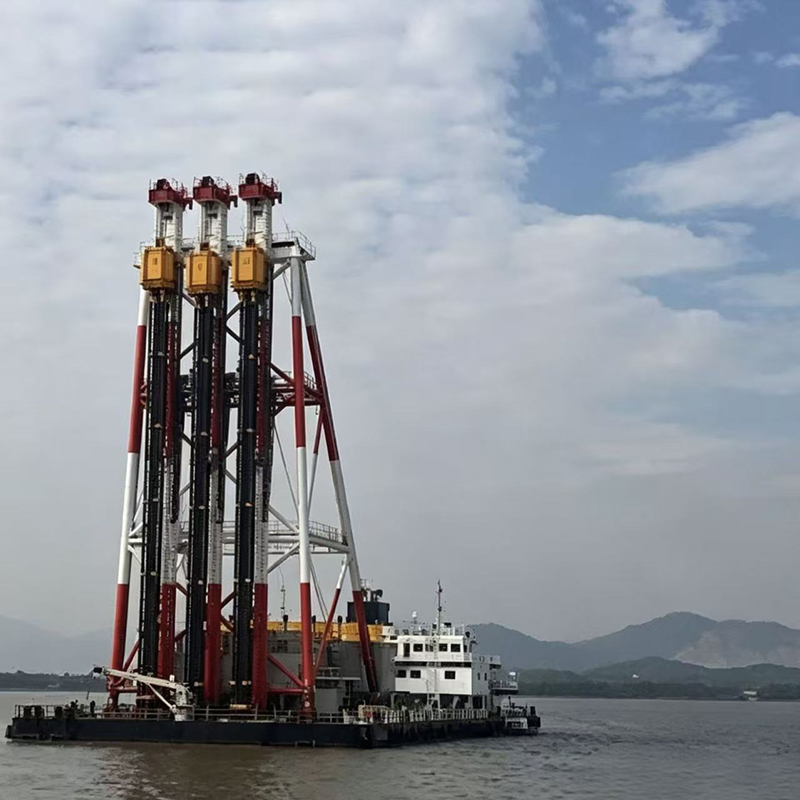
HKIA Third Runway: Offshore DCM Grout Supply at 40 m3/h
The third runway at Hong Kong International Airport is one of the largest aviation reclamation projects built in recent years. Much of the land the runway and its associated taxiways stand on was created by deep cement mixing: an offshore fleet of DCM barges treating soft marine deposits in place so that the reclamation above them behaves as engineered ground rather than as sediment.
Project overview
The scope was massive offshore Deep Cement Mixing reclamation for the airport expansion. DCM is a volume business. The barges work continuously, their output is measured in treated cubic metres per shift, and the slurry plant that feeds them is upstream of everything: if it stops, the fleet stops.
The technical challenge
Two things made this demanding. The first was intensity: high-intensity, 24/7 continuous slurry supply. Continuous is the operative word. A plant sized for a campaign with natural breaks behaves very differently from one that is expected to run without pause for weeks.
The second was the environment: an extreme marine setting with high salinity and humidity. Salt-laden air attacks coatings, enclosures and electrical connections, and on an offshore campaign there is no convenient moment to deal with it.
The EIZOO solution
The plants deployed were the AGP-M (Marine) Series, delivering 40 m³/h throughput to match the demand of large-scale offshore DCM barges. Matching output to the fleet is the sizing question that governs an offshore campaign: too small and the barges wait, too large and you have paid for capacity that never runs.
The key achievement was high-throughput reliability — sustained 24/7 operation with zero rig downtime, which demonstrated the durability of the heavy-duty transmission systems under continuous marine loading.
What continuous offshore duty demands of a plant
- Throughput matched to the fleet, not to a shift average. Size against the peak draw of the barges working together, then confirm the powder line and water supply can hold it.
- Transmission and drive durability. Continuous duty turns minor weaknesses into failures. Gearbox, coupling and bearing specification matter more than on intermittent work.
- Corrosion protection as a design input. Marine coating, enclosure rating and material choices need to be in the original specification.
- Spares and service access. Offshore, a part that takes three days to arrive costs three days of fleet time. What is stocked matters as much as what is fitted.
- Supply continuity. Cement and water logistics are part of the plant specification on an offshore campaign, not an afterthought.
Lessons that transfer to other DCM work
| Decision | What offshore DCM changes |
|---|---|
| Output sizing | Match the barge fleet peak draw, not the daily average |
| Transmission specification | Continuous duty rating replaces intermittent rating |
| Corrosion protection | Marine coating and enclosure rating become primary line items |
| Spares strategy | On-site critical spares are cheaper than fleet downtime |
| Powder and water supply | Logistics capacity sets the achievable output |
Related equipment and reading
Offshore campaigns of this scale are typically served by marine-configured plants with integrated bulk storage. See our notes on the AGP-M500 marine digital grout plant, on selecting a marine grout plant for offshore DCM, reclamation and port work, and on the power and water utilities that decide whether a plant reaches full output.
Frequently asked questions
Why is 24/7 continuous duty harder than the same output in shifts?
Because nothing cools down, nothing gets inspected between cycles, and wear accumulates without the natural breaks that let a crew catch a problem early. Every component has to be rated for continuous service rather than intermittent service.
How should output be sized for a DCM campaign?
From the peak simultaneous draw of the barges you intend to run, with allowance for the logistics that keep cement and water arriving. Sizing against a daily average under-delivers exactly when the fleet is working hardest.
What causes most unplanned stops offshore?
Supply interruptions and corrosion-related faults, more often than the mixing or pumping stage itself. That is why logistics and coating specification deserve as much attention as output.
Does a marine plant differ from a land plant beyond the coating?
Yes. Layout, access for maintenance, enclosure rating, bulk storage integration and how the plant is secured and transported are all configured differently for marine service.
Related reading
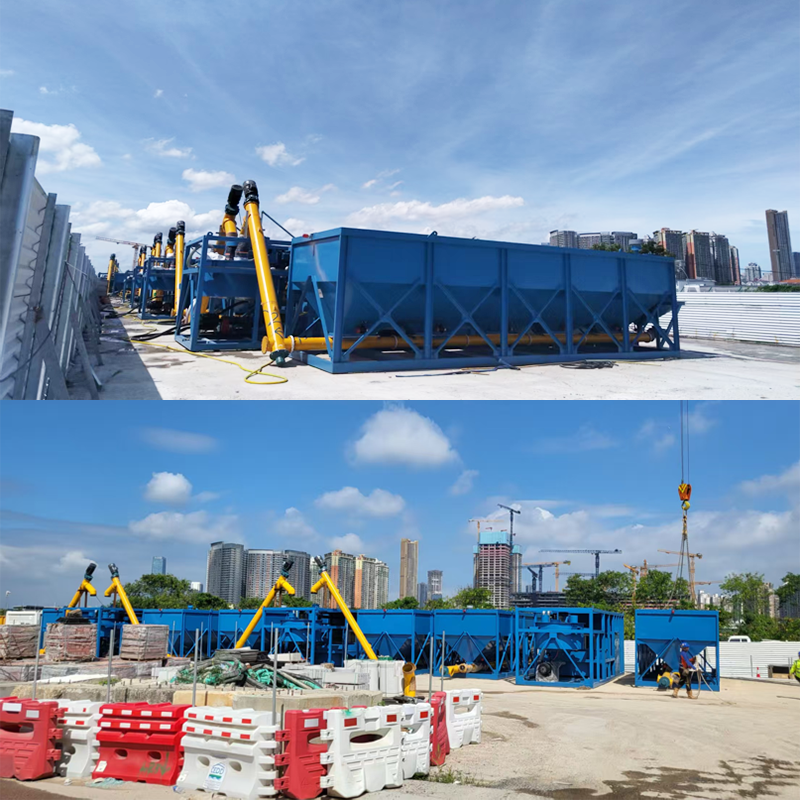
Lok Ma Chau Loop: Precision Grouting with Data Traceability
The Lok Ma Chau Loop is a development site in an ecologically sensitive area on the boundary between Hong Kong and Shenzhen. Projects in this position carry a different burden from an ordinary urban site: the ground treatment itself has to be demonstrable, because the environmental and structural consequences are both scrutinised and both permanent.
Project overview
The scope was precision soil stabilisation and foundation reinforcement in an eco-sensitive border zone. Precision here is not marketing language — it describes a treatment where the delivered binder content, depth and uniformity all have to sit inside specified limits, and where over-treatment is as much of a concern as under-treatment.
The technical challenge: full data traceability
The governing requirement was 100% construction data traceability. The project demanded strict adherence to the RSS (Real-time System for Site Management) digital audit, which means every aspect of the works had to be captured, time-stamped and retrievable rather than reconstructed from shift paperwork afterwards.
For a grouting package this is a demanding requirement. It is not enough to record that a batch was mixed; the record has to tie a specific volume, a specific mix, a specific pressure and flow history and a specific location together, in a form an auditor can follow. Manual records cannot meet that standard at volume, and records generated separately from the control system can always be questioned.
How it was met
The plants supplied to the site integrated EIZOO Smart PLC Monitoring with encrypted data logging, generating tamper-proof grouting reports in real time. Because the data originates in the control system that is actually batching and pumping, the report is a by-product of the work rather than a parallel manual exercise — which is what makes it defensible in an audit.
The result was full compliance with Hong Kong CEDD and RSS audit standards, with total transparency across environmental safety and structural integrity. The practical benefit for the contractor was that compliance evidence existed continuously, instead of being assembled under time pressure at handover.
What this means for similar projects
| Requirement | Implication for the plant | Common gap |
|---|---|---|
| Real-time data capture | Instrumentation integrated with the control system | Data logged by a separate device after the fact |
| Tamper-proof records | Encrypted logging and secure export | Editable spreadsheets |
| Precision dosing | Weighing and metering accuracy verified by the record | Volumetric dosing with assumed accuracy |
| Audit traceability | Every batch tied to location, time and parameters | Shift summaries that cannot be reconciled |
| Environmental assurance | Over-treatment and spill detectable in the data | No record to demonstrate containment |
The recurring lesson from projects run under a digital audit is that traceability has to be designed into the plant. Added afterwards, it produces records that are expensive to generate and easy to challenge.
Related reading
For the underlying equipment decisions, see why pressure and flow printout improves grouting QA/QC, the W/C ratio, flow and pressure printout checklist, and how much automation a cement grout plant actually needs.
Frequently asked questions
What is the RSS digital audit?
The Real-time System for Site Management is a Hong Kong framework that requires construction activities to be captured and reported digitally as they happen, rather than reconstructed from paperwork. On this project it set the standard for what the grouting records had to contain.
Why is encrypted logging important rather than ordinary logging?
Because a record that can be edited is a record that can be challenged. Encryption and controlled export are what make a compliance record defensible when someone audits it months later.
Does real-time reporting slow the work down?
It should not, if it is generated by the control system itself. The slowdown comes from parallel manual record keeping, which is exactly what an integrated system removes.
Is this level of traceability only required on public works?
Public digital-audit frameworks have driven adoption, but private developers increasingly ask for the same records because they reduce dispute risk at handover.
Related reading
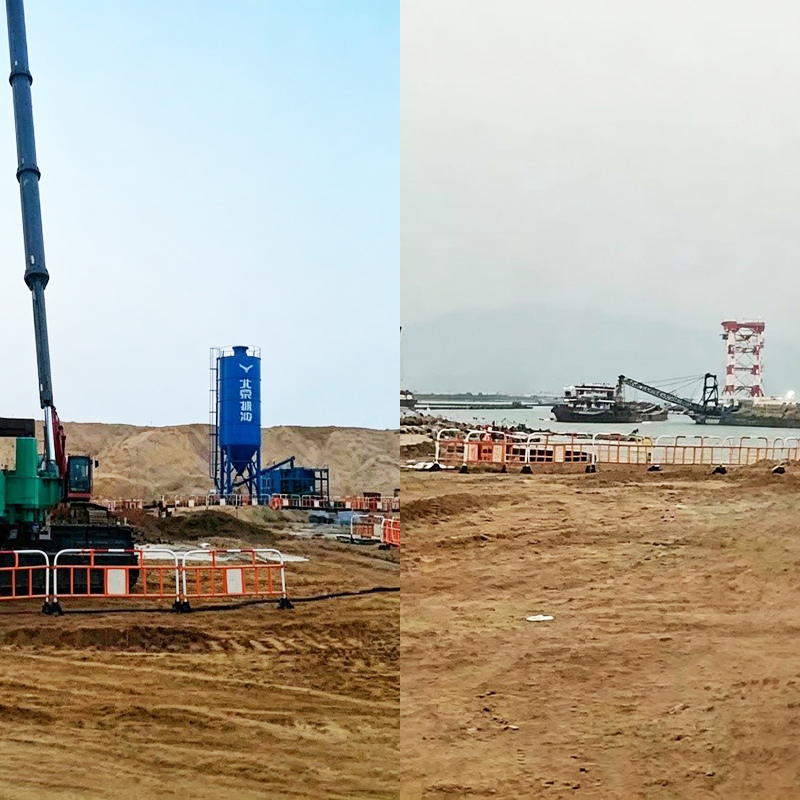
Hong Kong-Zhuhai-Macao Bridge: Island Foundation Grouting
The Hong Kong-Zhuhai-Macao Bridge is a fixed link across the Pearl River Estuary, combining a long bridge section with an immersed tunnel and two artificial islands that carry the transition between them. The islands are constructed reclamations standing in open water, and the strata beneath them had to be treated before they could carry the loads of the tunnel approaches and the bridge transition structures. Foundation reinforcement for the Hong Kong section artificial island ran in 2015.
What the site asked of the grouting equipment
Two requirements governed the work. The first was corrosion: the plant sat in an environment of intense marine salt spray, which attacks structural steel, electrical enclosures, fasteners and any exposed machined surface. Equipment that performs well inland can lose a season to corrosion on an exposed marine reclamation.
The second was documentation. Grouting in deep-sea strata carries requirements on both grout strength and data integrity. When the work is below water and permanently inaccessible, the record of what was injected is the only evidence that the specification was met.
How the plant was configured
Physical activation of the slurry
The units used EIZOO’s high-intensity shear activation approach. Cement agglomerates that survive conventional mixing leave unhydrated cement in the grout and increase bleed, which matters more when the grout has to perform in saturated marine strata. Driving the dispersion harder converts more of the cement and produces a more stable suspension.
Heavy-duty marine protection
The plants were engineered with a field-proven marine coating system specified to withstand the salt spray loading on site. Coating is the least visible part of a grout plant specification and one of the most consequential on a marine campaign, because corrosion damage accumulates silently and then removes a machine from service at the worst moment.
Computerised control with encrypted data logging
The plants carried EIZOO’s computerised control system, which logged data in encrypted form and exported reports securely. That produced audit-ready compliance documentation automatically, at a time when digital record requirements were far less common than they are now.
The outcome
The units ran reliably through a complex construction cycle. For a project of this type, that is the result that matters: the grouting line is not the headline scope, and its job is to stay out of the way while the island structures go in. Stable operation across the full cycle, with the compliance record generated as a by-product, is what a marine foundation grouting package is supposed to deliver.
What buyers can take from it
| Requirement on this project | What it implies for a plant specification |
|---|---|
| Continuous marine salt spray exposure | Specify the coating system, enclosure rating and fastener material, not just the output |
| Grout strength in deep-sea strata | Mixing energy and dispersion matter as much as the mix design |
| Data integrity and reporting | Encrypted logging and export belong in the original specification, not a retrofit |
| Long, complex construction cycle | Wear parts, spares and service access decide uptime more than nameplate output |
Two of these — corrosion protection and data records — are routinely left out of enquiries and then requested once the plant is on site. Both are far cheaper to specify than to add.
Related equipment and reading
Marine campaigns of this type are typically served by plants configured for continuous duty and protected against salt loading. For background on the specification decisions involved, see our notes on marine grout plant selection for offshore DCM and reclamation, on the AGP-M500 marine digital grout plant, and on what physical slurry activation does to a cement grout.
Frequently asked questions
Why does salt spray matter so much for a grout plant?
Because corrosion attacks the parts that keep a plant running: enclosures, connectors, fasteners and structural steel. On an exposed marine site the failure is rarely sudden; it is accumulated damage that removes a machine from service when you can least afford it.
Why is data integrity specified on marine works?
The treated ground is below water and permanently inaccessible after construction. The injection record is the only evidence available that the specification was achieved, so it forms part of the project deliverable.
Is high-intensity shear activation necessary on every job?
No. It earns its place where bleed, penetrability or strength at a fixed cement content governs. On high-volume void filling where strength is not the limiting factor, it is generally not the right investment.
Can data logging be added to an existing plant later?
It can, but retrofitting instrumentation and integrating it with the control system costs far more than specifying it in the original build, and the record may not be accepted as tamper-evident.